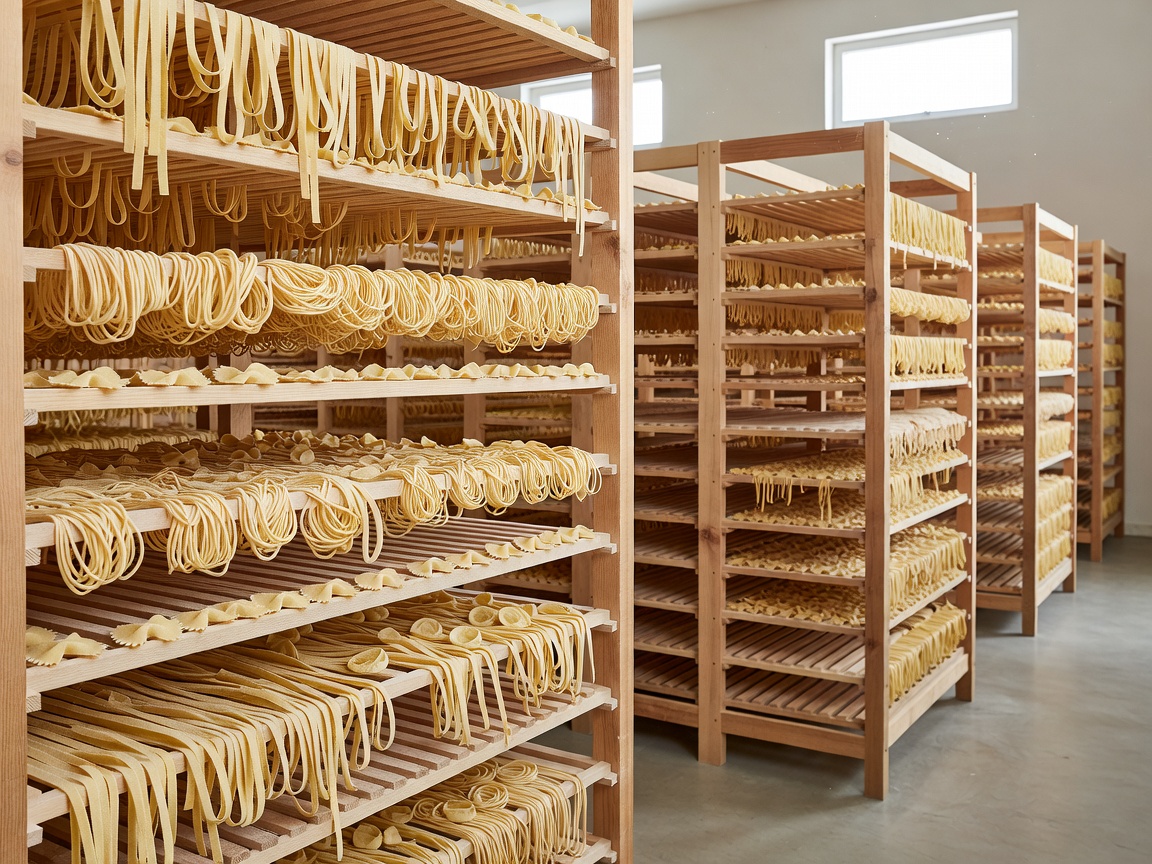
Separate drying from fresh storage
Fresh chilled pasta and shelf-stable dried pasta are distinct product categories with different process controls. Leaving fresh pasta uncovered until it feels firm does not establish shelf stability. Filled pasta adds further complexity because the filling can behave differently from the surrounding dough. Decide which product you are making before discussing a drying cycle, and obtain product-specific technical advice for commercial manufacture.
For dried pasta, water must travel from the interior toward the surface and then into the surrounding air. Shape geometry affects that journey. A thick tube wall, a thin ribbon and a folded piece do not necessarily dry at the same rate. Formulation, initial moisture and the amount loaded into the chamber change the task as well. This is why a borrowed schedule cannot be treated as a universal specification.
Understand the interacting controls
Air temperature influences drying and the behaviour of the product. Relative humidity affects how readily moisture can leave the surface. Air movement carries moisture away but needs to be distributed appropriately. These controls interact: changing a fan setting without considering humidity or product position can create uneven results rather than simply speeding the process.
If the exterior loses moisture much faster than the interior, stresses can build and quality can suffer. Cracks may be visible immediately or become apparent later. Conversely, poorly distributed air can leave slow-drying pockets within a load. A suitable cycle may use different phases to manage moisture movement and redistribution, but the sequence must be developed for the actual product and dryer.
Slow is a description, not a verdict
Traditional low-temperature drying is an important part of some producers’ identity. Its value should be discussed in relation to raw materials, flavour, texture and the whole production system. A longer cycle is not automatically safer or better. Extended time under unsuitable conditions can create problems, and modern higher-temperature processes also require careful design and control.
Ask what a claim means in practice. Does the producer disclose a temperature range, shape-specific programmes and checks at release? Does “slow” describe every product or one flagship line? Protected products such as Pasta di Gragnano IGP have their own specifications; those requirements should not be assumed to apply to all pasta carrying an artisan description.
Measure the product, not just elapsed time
Moisture content expresses the amount of water in a product. Water activity describes how available that water is for processes including microbial growth. They are related but not interchangeable measurements, and a simple conversion should not be assumed. Neither a brittle snap nor a dry-feeling surface substitutes for a suitable measurement method.
Use calibrated or appropriately verified instruments and a sampling plan that reflects the load. Consider locations likely to dry differently, not only the tray nearest the door. Sample preparation, temperature and method affect results, so document them. A competent food technologist or accredited laboratory can help establish suitable release criteria, shelf-life evidence and the limitations of an in-house test.
| Stage | Useful record | Reason |
|---|---|---|
| Loading | Shape, batch, rack map and load quantity | Allows like-for-like comparison |
| Cycle | Time, temperature, humidity and deviations | Documents actual conditions |
| Release | Sampling locations, test method and results | Supports a justified disposition |
| Packing | Cooling conditions and package checks | Protects the achieved condition |
Investigate defects systematically
When a batch cracks, first compare the full records rather than immediately extending or shortening the next cycle. Look at dough consistency, wall thickness, loading density, chamber conditions and handling after drying. A visible defect can originate upstream. Keep affected product identified and on hold until it has been assessed; mixing it into an acceptable batch only makes the problem harder to trace.
Cooling and packing belong to the process. Moving warm product into unsuitable conditions can encourage unwanted moisture changes, and packaging must provide protection appropriate to the product and storage environment. Check seal integrity and avoid treating a decorative paper bag as automatically adequate moisture protection. Shelf-life decisions should consider the package actually sold, not an uncovered sample kept in an ideal room.
Do not assume a kill step
Drying is not automatically a validated pathogen-reduction treatment. Low-moisture products can retain hazards introduced earlier, even where growth is restricted. Hygienic raw-material handling and protection after processing remain essential. Build the process around a hazard assessment rather than assuming that a dry product is inherently sterile or that cooking instructions excuse poor manufacturing control.
Reading desk: Codex Alimentarius codes of practice, including guidance relevant to low-moisture foods; Food Standards Agency business guidance. No universal drying temperature, duration or shelf life is prescribed here.