Begin with the product brief
A filled egg pasta destined for chilled sale and a shelf-stable durum spaghetti are different manufacturing projects. Their flour choices, mixing behaviour, forming methods and safety controls should not be treated as interchangeable. Before adjusting a recipe, define the shape, intended cooking behaviour, storage conditions and route to market. A good dough is one that serves that whole brief, not simply one that feels pleasant in the hand.
Durum wheat semolina is central to many dried pasta traditions. Its particle size, protein characteristics and colour influence processing and the finished product. Soft-wheat flour is common in many fresh egg-pasta traditions, including the sfoglia associated with Bologna and Emilia-Romagna. These are useful starting points, not rules that make every regional pasta identical. Record the actual specification of the material you buy.
Read beyond the flour label
“Tipo 00” describes an Italian flour classification linked to refinement and ash limits; it is not a universal promise of high protein or suitability for every pasta. Two flours carrying the same classification can behave differently. Ask a supplier about protein, moisture, particle distribution and intended use. For semolina, consistency of granulation can be particularly important because larger particles take time to hydrate through their centres.
Keep supplier and lot information with each batch record. If a new delivery changes the dough, that record gives an operator something more useful than memory. Store flour dry, protected from pests and away from strong odours. Open sacks need identification and controlled handling. A beautiful raw material is still an ingredient requiring allergen management, stock rotation and checks at receipt.
Make hydration measurable
Express added liquid against flour weight, but distinguish added water from total water. Whole egg contributes water, protein and fat; it cannot be substituted gram for gram as though it were plain water. Flour also arrives with moisture already present. A percentage quoted without these details is incomplete, particularly when comparing a fresh egg dough with an extrusion mix.
Addition sequence matters. Gradual, even distribution can reduce dry pockets and wet lumps, while the mixer’s geometry determines how efficiently that distribution happens. Weigh ingredients rather than relying on volume measures. Record water temperature, mixing time and final dough temperature. Friction from mixing contributes heat, so a familiar recipe can behave differently when scaled into different equipment.
Sheeting brief
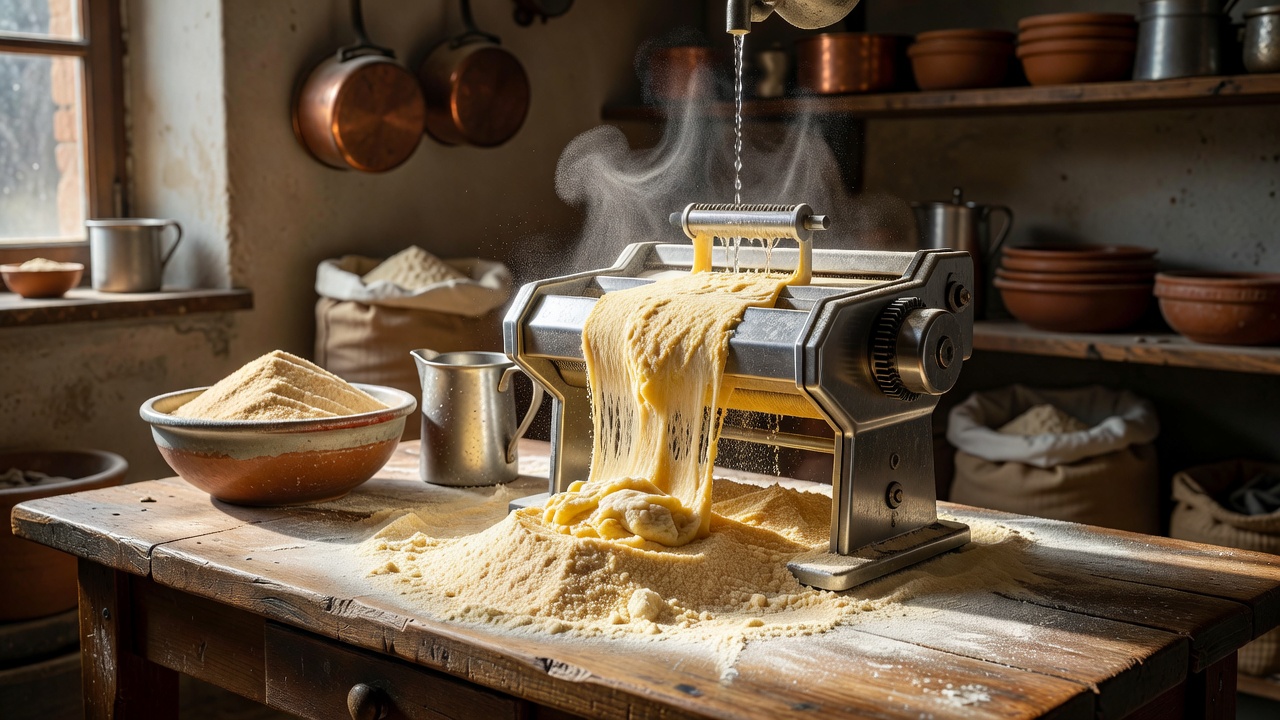
Seek a coherent dough that can develop into a continuous sheet without persistent tearing. Resting and staged reduction help distribute strain.
Extrusion brief
A controlled granular mix may be appropriate. Its behaviour under compression matters more than whether it resembles a hand-kneaded ball.
Develop enough, not blindly more
Mixing distributes moisture and helps establish the protein network that holds pasta together. More mixing is not automatically an improvement. Excessive work can raise temperature and change handling, while inadequate distribution leaves material that forms unevenly. Use a repeatable endpoint based on the equipment, appearance and measured conditions rather than a timer alone.
Resting allows moisture to redistribute and, for many sheeted doughs, helps reduce resistance during rolling. Cover dough to prevent a dry skin, identify its batch and control time and temperature. A rest is a processing step, not a preservation treatment. Dough containing egg requires appropriate hygienic handling; neither a traditional recipe nor a cool-feeling room establishes a safe holding period.
Run a small, useful trial
Change one factor at a time. Keep the flour lot, batch size and shaping method constant when investigating hydration. Note whether the dough crumbles, sticks, tears, springs back or leaves residues on rollers. Cook representative samples using the same test method and assess integrity as well as bite. Without a consistent cooking test, an apparent improvement may simply reflect a shorter boil.
| Observation | Check first | Record |
|---|---|---|
| Dry particles persist | Liquid distribution and hydration time | Addition sequence and rest conditions |
| Sheet tears repeatedly | Development, drying skin and reduction steps | Pass sequence and dough temperature |
| Extrusion varies during a batch | Feed consistency and equipment warming | Load, pressure where available, and product temperature |
For commercial production, connect these trials to a documented food-safety system. The Codex Alimentarius General Principles of Food Hygiene provide an established framework for good hygiene practices and HACCP. They do not provide a universal pasta recipe. Product-specific hazards, including wheat and egg allergens, must be assessed for the actual process and market.
Reading desk: Codex codes of practice; Harold McGee, On Food and Cooking, for background on cereal proteins and cooking. This article explains process decisions, not a validated commercial formulation.